Pages

Showing posts with label Book Awards Challenge. Show all posts

Wednesday, April 23, 2008

Book Awards Challenge Completed

Thanks to 3M for hosting this challenge. I read some books that were new to me and some that I probably wouldn't have without the challenge. Here's my finished list of books I read:
1. The Higher Power of Lucky by Susan Patron
2. The Amazing Maurice and His Educated Rodents by Terry Pratchett
3. To Kill a Mockingbird by Harper Lee
4. Bridge of San Luis Rey by Thornton Wilder
5. Bones by Jan Burke
6. Jonathan Strange and Dr Norrell by Susanna Clarke
7. The Book of Atrix Wolfe by Patricia McKillip
8. The Colony of Unrequited Dreams by Wayne Johnston
9. Shipping News by Annie Proulx
10. Westing Game by Ellen Raskin
11. Homeless Bird by Gloria Whelan
12. Bel Canto by Ann Patchett

My favorite: To Kill A Mockingbird
The one I liked the least: Shipping News
All the others I really liked and enjoyed reading them.

Tuesday, April 22, 2008

The Colony of Unrequited Dreams

by Wayne Johnston

I didn't expect to like this book as much as I did. The novel is about Newfoundland and centers on Joseph Smallwood, the real-life political figure who ushers the country through confederation with Canada and then becomes the first premier.

In writing a work of the imagination in part inspired by historical events, Johnston wanted “to fashion out of the formless infinitude of ‘facts’…a work of art that would express a felt, emotional truth... Adherence to the ‘facts’ will not lead you safely through the labyrinthine pathways of the human heart.” Johnston was 19 when he met the real Joe Smallwood; he was just starting out as a journalist, and Smallwood was less than complimentary about Johnston’s reporting. Although the politician died only in 1991, little was written about his life before the age of fifty, allowing Johnston some license to imagine his formative influences.

“I wanted to write a big book about Newfoundland in scope and in vision. I couldn't think of a bigger character whose life touched on more themes, involved the whole of Newfoundland more completely than Smallwood did.” Smallwood saw Newfoundland in terms of “unrealized talent and unfulfilled ambition”; his life was somehow emblematic of the land. Moreover, says Johnston, “He was so prone to making mistakes and so fallible, and he combines so many contradictions in his personality. His quest, like that of many great literary figures of the past century, is to overcome these divisions.” The completely invented character of Fielding, meanwhile, “is like me”, says Johnston. “I share her view of Newfoundland.”

The title of the book, Johnston says, evokes “the nostalgia Newfoundlanders have felt for the possibilities of the island, and that they still have for the future. Joe is always searching for something commensurate with the greatness of the land itself, but he can't find it, and it's driving him mad…Newfoundland is that kind of place. It makes you want to live up to the landscape, but on the other hand it offers you no resources to do so. There's always this constant yearning that at least for my part helped me to start writing.”

You can read more of Johnston's essay about Unrequited Dreams by clicking on the link.

Johnston creates a larger-than-life character in Sheilagh Fielding who counterbalances Smallwood's smaller-than-life personality. It was their relationship that most engaged my interest. I was happy to discover that Johnston has written a whole novel about Fielding, titled The Custodian of Paradise. Next to Newfoundland itself, Fielding was the most complex character. She had depth, mystique, struggles and strength. Whereas Smallwood lacked all those traits. And yet, on the surface he appears to be an upstanding citizen and she a retrobait.

Most of the book is told in the1st person narrative with sprinklings of personal letters, Newfoundland history, and newspaper articles written by Fielding. I thought this was a very effective way of helping the reader understand Newfoundland better and to provide other views of events and people than just Smallwoods.

I would love to sit in on book discussion groups all across Newfoundland when they are discussing this book. The treats would definitely take a back seat to the lively and emotional discussion. To many in Newfoundland Smallwood is a hero and to the rest he is a traitor. I can understand both sides. Actually, I would welcome a good discussion of this book with any bookclub.

I would like to have had a map of Newfoundland with major areas and cities highlighted and also a map of St. John's included in the book. I lived in St John's when I was little and visited there this summer, but was unfamiliar with the area called the brow. I am assuming it's the peninsula of land where Ft Amherst Lighthouse is located.

I highly recommend this book. If you have any connection to Newfoundland it's a must. If you don't, I think you'd still be immensely satisfied.

Thursday, April 17, 2008

Amazing Maurice and His Educated Rodents

by Terry Pratchett

The American cover is not the least bit cute or enticing, so I'm showing the English version even though that's not the one I was able to hold in my hands.

Some books I've read recently are based on fairy tales; this book takes the Pied Piper tale and "turns it right on it's head" according to the front cover. I think that's an apt description. Maurice is a talking cat who has teamed up with a "stupid-looking boy" and some talking mice in a Pied Piper-like scam.

Pratchett's characteristic humor defuses the ick factor allowing me to actually like the rats and tolerate their environment. In fact, I found myself cheering for the rats, which is to be expected since they are the heroes along with Maurice, the boy and a town girl.

I found myself thinking this was the perfect book to engage the interest of young boys. Although, I need to add a word of caution: the book gets quite terrifying in the last half. I didn't have any nightmares, but I could imagine that some children might. I think this book should be categorized as YA, not children's. The scary part ends and the book finishes on a lighter note. I really liked this book and highly recommend it to adults and cautiously recommend it to young adults.

The Amazing Maurice and His Educated Rodents was awarded the Carnegie Awards in 2001. This award is given for outstanding children's or YA literature.

Saturday, March 15, 2008

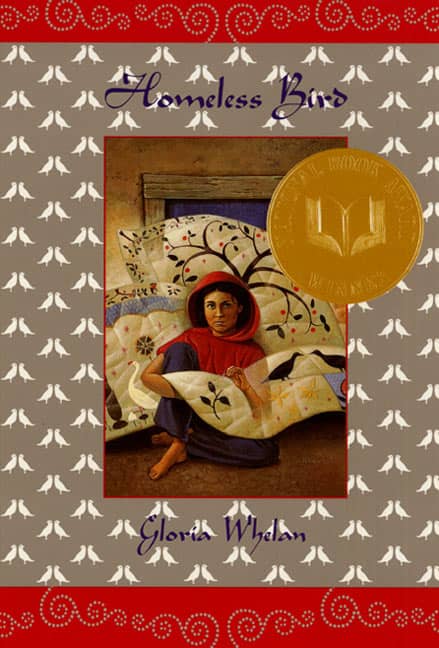
Homeless Bird

by Gloria Whelan

Homeless Bird won the National Book Award for Young People's Literature in 2000. Aimed at the audience of 9 to 12 year olds, it has charm for any age reader. I often found myself wondering about young Koly throughout the day.

Koly's parents arrange for her marriage to a young man in another village when Koly is only 13 years old. She tries to catch glimpses of her husband during the wedding and hears his voice for the first time as he says the wedding vows. He is much younger than the 16 years his parents were told, perhaps even younger than Koly, and he is very sick. Soon after the wedding, the bridegroom dies and Koly becomes a widow.

I felt a great deal of pain for Koly who tries to make the most of her situation even though she is filled with despair at times. Whelan handles the isolation of widows in India in a gentle manner for young readers, while providing glimpses of the fear and despair, the separation from family and the trials of both young and old women who are not taken care of in society.

I highly recommend this little gem.

Saturday, February 09, 2008

Jonathan Strange and Mr Norrell

by Susanna Clarke

Whew! Finished at last. Seems like I spent months on this book but it was really only 3 weeks. I read several other books at the same time because I would get a bit tired of JS&MN and needed other outlets.

I enjoyed the basic story involving the two magicians, the unnamed slave, the gentleman with the silvery hair and the two enchanted women. Much of the groundwork held my interest, but there was just too much. I think the book would have been totally wonderful if some of it had been left out.

I came to a vivid realization that England has a wonderful history steeped in magic. We don't have that in the young country of America. One review I read on JS&MN talked about the mythological references. I probably missed most of that because I don't have a good background in myths. Because of this book, I have an increased interest and that's a good thing.

I appreciated the history and enjoyed this reference to the London servants making fun of some imported servants brought in from Northern England. "...the used words like goosegogs, narrow-grass, betty-cat and battle-twigs, when they should have said gooseberries, asparagus, she-cat and earwigs."

At one point Strange gave Norrell a list of books he wanted to borrow from Norrell's library. "It was not a list to delight Mr Norrell's soul. It was full of first thoughts crossed-out, second thoughts crossed-out and third thoughts put in at angles and made to wriggle around other words that were in the way."

And this commentary on arguments between a married couple.
In the end is it not futile to try and follow the course of a quarrel between husband and wife? Such a conversation is sure to meander more than any other. It draws in tributary arguments and grievances from years before - all quite incomprehensible to any but the two people they concern most nearly. Neither party is ever proved right or wrong in such a case, or, if they are, what does it signify?"

Monday, November 12, 2007

Bel Canto

by Ann Patchett

I started this remarkable book in August because it was the selection for my f2f book club. Unfortunately I didn't finish it and I had to set it aside to finish up a few challenges. I picked it back up this month and finished the last half.

Bel Canto received the Orange Prize for Fiction and the PEN/Faulkner Award in 2002. The term 'Bel Canto' refers to a style of singing. Since part of the book's focus is on a woman who mesmerizes her audiences with her beautiful singing the title is apropos.

The story is set in an unknown South American country. In an attempt to draw foreign money into their economy the country hosts a birthday party for a rich Japanese businessman with a famous opera singer providing the entertainment. In the middle of the party the guests are taken hostage by a radical militant group. All the woman but one, the opera singer, are released. The hostage situation drags on for over 4 months.

"What begins as a panicked, life-threatening scenario slowly evolves into something quite different as terrorists and hostages forge unexpected bonds and people from different continents become compatriots. Friendship, compassion, and the chance for great love lead the characters to forget the real danger that has been set in motion." (from the back cover)

I really enjoyed my first Patchett book and look forward to reading more. She skillfully conveyed the feeling of complete closure from the real world. The hostages and terrorists both lived inside a bubble of space and time.
"The day no longer progressed in its normal, linear fashion but instead every hour circled back to its beginning, every moment was lived over and over again. Time in the manner in which they had all understood it, was over."

"Time could barely pull the second hand forward on the clock..."

". . . as if the world had become a giant train station in which everything was delayed until further notice."
A few other quotes that I liked. I won't share all the passages I marked.
"The quality of the gift depends on the sincerity of the giver. It also helps if the gift is something the receiver actually wants."

"At the moment one is sure that all is lost, look at what is gained."

"Step back," Roxane said, and shooed them away with her hand. "I'm going to want that air."

"It's easier to love a woman when you can't understand a word she's saying."

"He would not have chosen to draw attention to himself, and without his playing the story might have missed him altogether. But there was a need, a specific request, and so he stepped forward."

Thursday, October 11, 2007

Bridge of San Luis Rey

by Thornton Wilder

I didn't realize that Thornton Wilder wrote anything but plays. He authored the Pulitzer Prize winning plays, Our Town (1938) and The Skin of Our Teeth (1943), but he also wrote several novels. He won his first Pulitzer Prize in 1928 for The Bridge of San Luis Rey.

When I first listed this book for the By-the-Decade Challenge as my 1920's selection, I thought it was a war story. Even before I read the book, I discovered that I had the story for The Bridge on the River Kwai in mind. Obviously my mind had criss-crossed paths before it ever reached 'The Bridge.'

Wilder's Bridge concerns itself with 5 people who fell to their deaths when Peru's finest bridge collapsed in 1714. A Franciscan monk, Brother Juniper, witnesses the tragedy and begins to wonder if what seemed like random misfortunes were actually part of God's plan. He spends years researching the lives of the five people and then compiles and publishes his findings. The results were unexpected.

I liked this book, both for it's quickness and the questions it posed: Is there an overall plan by an unseen God? Is there a purpose behind tragedy? Wilder doesn't really answer these questions. In fact, he doesn't even address them in so many words, rather the story unfolds and the reader is left asking these questions.

Wednesday, September 19, 2007

The Westing Game

by Ellen Raskin

I read this book for my f2f book group, for the Newbery Challenge and the Book Awards Challenge. Whew - three with one book!

It's a fun little mystery written for reading levels 4-12. I was a bit confused for the first half of the book. Maybe I was trying to make more out of it than I should have, or tried to keep track of all the bits and pieces of clues. Once I stopped doing that and just let the book unfold, I enjoyed it more.

"The game is "Who Killed Sam Westing" and the winner receives his estate, worth millions. Sixteen people, all residents of Sunset Towers --- an apartment building on Lake Michigan --- are named as heirs to the fortune. They are split into eight unusual pairs and given clues to solving the murder. Through snowstorms, power failures and bombs they play the game, leading to deception and intrigue. Everyone is a suspect, no one is ever who he or she seems to be, and no one except the reader has all the answers (and sometimes not even then). Don't forget Sam Westing's most important instruction to the heirs: "It's not what you have, but what you don't have, that counts."

After twenty-five years, THE WESTING GAME --- written by the late beloved author Ellen Raskin and winner of the 1978 Newbery Award --- is still remarkable for its diverse, interesting characters, its plot twists, and an ending that no one inside or outside the novel could predict. Woven into the mystery are insights into family relations, dishonesty, courage and finding a sense of self. The absurdities of plot lend a humorous air but never distract from the story. There is something new to be found with every reading, from clues to connections between characters." from a review by Carlie Webber at teenreads.com

I liked this book and found it to be very clever. It's satisfying to be familiar with books that receive awards and also, those that are discussed often.

Friday, September 14, 2007

Bones

by Jan Burke

I've discovered another author that I am going to want to read more of her work. This book runs along the same lines as a Dean Koontz book. Lots of intrigue and a heart-thumping pace. Sometimes the line between a cozy mystery and a regular mystery is vague and hard to define. No question about this book - It is NOT a cozy.

This is book 5 or 6 in the Irene Kelly mystery series. I've already got the first in the series mooched and it's on its way. Irene is a journalist included as part of an expedition to find the bones of a woman murder 4 years earlier. Also in the group is the murderer. Right at the first the reader knows who the murderer is and so does everyone in the group. He has made a plea bargain for a life sentence, instead of a death sentence, if he will show them the grave.

The only thing I didn't like about the book was the number of characters. I wasn't the only one having trouble keeping everybody straight, another person who had checked out this book before me had written the names of all the people on the investigative team on the back blank page. Oh, he/she had also blackened out the 8-10 bad swear words in the book!

I liked the suspense and a couple of unexpected twists and even though I figured out the accomplice long before the end, I still enjoyed reading to see if I was correct. I think Jan Burke is a good writer and look forward to reading more in this series.

Tuesday, September 11, 2007

The Higher Power of Lucky

by Susan Patron

This is one of my selections for the Newbery Challenge. The Higher Power of Lucky won the Newbery Award for 2006 and received much criticism because it contained the word scrotum. I thought Lucky's foster mother, Brigitte, explained the meaning to the inquisitive 10-year-old in a sensible way.

Lucky is in search of the higher power that she has overheard different members of the 12 step program (AA) discuss at their meetings. She's in desperate need of this power to insure her happiness and to keep her foster mother from returning to France and abandoning her to an orphanage.

This is a beautiful, sweet book that address childhood fears, bravery, and misconceptions. Patron does an excellent job with the characterization. Lucky and her two friends, Lincoln and Miles become real people in just a very short time. I'd like to see other books by Patron that focus on each boy. I'm sure they would be every bit as touching as Lucky's story.

Sunday, July 22, 2007

Shipping News

by Annie Proulx

I have mixed feelings about this book. There were times it seemed as if the author was making a list. The descriptions seemed broad at first, but eventually I could almost picture the main character. There was a certain Newfoundland feel to the book. Please don't ask me what I mean by that, because I haven't quite vocalized it to myself yet. I'm glad I listened to this book, but I'm not sure that I would recommend it to anyone else. I doubt I will ever reread it, though I will probably watch the movie.

The best part of my experience with this book was listening to it while driving in Newfoundland. Sharing this experience with my husband helped because I'm not sure I would have persevered without his encouragement. Discussing the book in view of our experiences and the sights of the island helped, too.

We talked with a nice man at the Bookworm Bookstore in Gander who didn't think highly of the book. He said Proulx didn't do her research and that there were too many things that didn't ring true of Newfoundland life. For one thing, no one eats squid burgers.

*Just a side note* We bought a copy of The Day the World Came to Town from Brad at the Bookworm. He regaled us with some wonderful, personal stories of that time when the 747 had to land in Gander due to the tragedy with the twin towers on 9-11. After he and I had talked for quite awhile I turned around and noticed another customer. I apologized and said someone should have told me I was talking too much. They said you'd never hear a Newfoundlander say anything like that. That's what they do best is talk! I shook hands with both men and we left the bookstore.