Pages

Showing posts with label TBR Challenge. Show all posts

Tuesday, April 08, 2008

Sixpence House: Lost in a Town of Books

by Paul Collins

I mooched this book last year during the Something About Me Challenge. It was one of the books Nattie listed as one that told something about her. The part of the title - Lost in a Town of Books - naturally drew my interest. I didn't get it read for the Something About Me Challenge, but since it was on my shelf, it was available for some of this year's challenges.

Sixpence House is a memoir of Paul Collins' experiences in the bookish town of Hye-on-Wye. He moved from San Francisco to the small community in the Welsh countryside.

One of my favorite parts of the book was Collins' comparisons of things English with things American from aspects of daily life to food and architecture. For example, the shower: "Every shower in Britain has some sort of Heath Robinson mechanism who devised for all British showers cheap plastic box with tubes that go nowhere and buttons that do nothing, except for the one that will scald you. Apparently it is some kind of filtration system for removing any pleasure one might have in washing. When I was a little boy in America, the pounding water pressure would allow me to stand with my eyes closed in the sower and imagine that I was flying a wounded P-57 back to base, with rain whipping into the cockpit; or to pretend that I was getting heroically smashed against a brick wall by a water cannon wielded by riot police. But I'm not sure what British boys can imagine in their showers. {Perhaps they pretend that they are standing under a rusted and leaking pipe in an unlit boiler room. Or that someone is weeing on them from a great height." (I've experienced showers just like that in America.)

Collins told about his love of literature that developed when his parents would go to antique sales. He always came away from those sales with books. He especially like old science books. "My most beloved book was a relative youngster: a 1951 volume by Willie Ley called Rockets, Missiles and Space Travel. And yet the creamy plate paper, the yellow embossing of a pointy fifties sci-fi rocket on the cover, the feeling of reading Ley's speculations on a moon shot and knowing more than the author did - the true classical sense of irony, where the audience is aware of the ending even as the players of history are not - these things appealed to me in a way that I couldn't explain." As a science teacher I used to experience this feeling often.

I laughed and was amazed at this accounting: "This is a country where citizens will not grumble or take action at much of anything unless it interferes with their cup (of tea). Some years ago, a species of English tit bird discovered that if they pecked through the foil cap on milk bottles, they could suck down a cream feast so sumptuous that they could barely stagger away afterward on their little bird feet. Other varieties of tits quickly learned by watching, and suddenly the nation's cream teas was in moral peril; whereupon redesigned bottle caps were procured with impressive alacrity."

I enjoyed this morsel from a letter from Helen Hunt Jackson to Emily Dickinson(before Dickinson was well published): "I have a little manuscript volume with a few of your verses in it - and I read them very often - You are a great poet - and it is a wrong to the day you live in, that you not sing aloud." I think we could all take that counsel to heart - whatever our gifts and talents are we should share them with those around us.

All-in-all I really enjoyed Sixpence House. I found myself wondering if I could ever convince Candleman to spend a year in the Welsh countryside.

Saturday, March 15, 2008

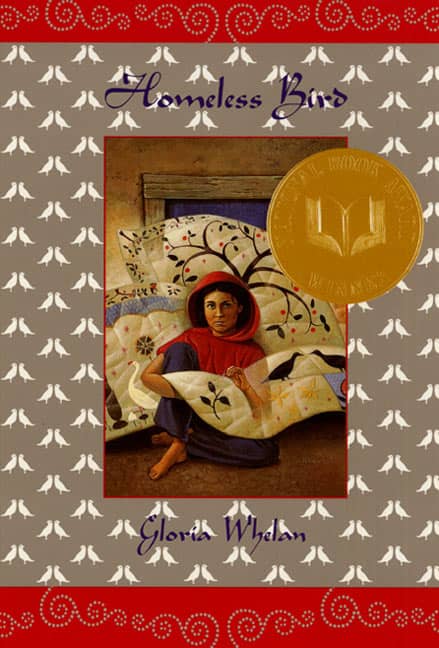
Homeless Bird

by Gloria Whelan

Homeless Bird won the National Book Award for Young People's Literature in 2000. Aimed at the audience of 9 to 12 year olds, it has charm for any age reader. I often found myself wondering about young Koly throughout the day.

Koly's parents arrange for her marriage to a young man in another village when Koly is only 13 years old. She tries to catch glimpses of her husband during the wedding and hears his voice for the first time as he says the wedding vows. He is much younger than the 16 years his parents were told, perhaps even younger than Koly, and he is very sick. Soon after the wedding, the bridegroom dies and Koly becomes a widow.

I felt a great deal of pain for Koly who tries to make the most of her situation even though she is filled with despair at times. Whelan handles the isolation of widows in India in a gentle manner for young readers, while providing glimpses of the fear and despair, the separation from family and the trials of both young and old women who are not taken care of in society.

I highly recommend this little gem.

Wednesday, November 07, 2007

2008 TBR Challenge

Mizbooks is again hosting the TBR Challenge. YAY! This is one of the first challenges I signed up for last year and it remains one of my favorite. The whole point is to choose books you've been wanting to read and/or books you've had on the list or library shelf for too many months. I have more this year to choose from than ever before.

Other book bloggers have made so many great recommendation and I've been introduced to Bookmooch which makes it so easy to acquire books. The list grows and the shelves moan. I NEED this challenge. The real challenge is choosing just 12 books.

I narrowed the choices to this small list of 12. I have got to stop buying and trading books. And I should probably quit reading all those fabulous book blogs that I love.
1. Good Omens by Terry Pratchett and Neil Gaiman
2. Lewis Carroll Biography by Morton N. Cohen
3. Yarrow by Charles de Lint
4. Sixpence House by Paul Collins
5. And There Was Light by Jacques Lusseyran
6. Homeless Bird by Gloria Whelan
7. Singer of All Songs Kate Constable
8. Birth House by Ami McKay
9. Equal Rites by Terry Pratchett
10. Grandmother and the Priests by Taylor Caldwell
11. Cruel Miracles by Orson Scott Card
12. The Sign of the Book by John Dunning

Saturday, September 22, 2007

Two Challenges Finished

When I finished reading Brainiac I completed the TBR Challenge and the Non-fiction Five Challenge.

It was a long, long time ago that I picked out my books for the TBR Challenge - I couldn't even find the post with my original list of books. I wanted to see if I read all the originals or if I made any changes along the way. Oh well. Here's the list I did read:

  1. The Woman in White by Wilkie Collins
  2. Gone With the Wind by Margaret Mitchell
  3. I Am the Messenger by Mark Zusak
  4. Pardonable Lies by Jacqueline Winspear
  5. At Some Disputed Barricade by Anne Perry
  6. Brainiac by Ken Jennings
  7. Flowers for Algernonn by Daniel Keyes
  8. Voyager by Diana Gabaldon
  9. Yellow Wallpaper by Charlotte Perkins Gilman
  10. House of Spirits by Isabelle Allende
  11. Booked to Die by John Dunning
  12. The Memory Keeper's Daughter by Kim Edwards

The only one I didn't care for was House of Spirits. Numbers 4 and 5 I read to further my progress in two different series I was into. (Still am.) Book 11 started me on another series. All in all, some really good books.

I was able to find my original list of books to be read for the Non-Fiction Five challenge. I posted this list on March 7, 2007. At the top is the original list and after that are the books I actually read.

I didn't read the original numbers 1, 2, and 3. In addition to numbers 4 and 5 I read

  1. My Grandfather's Blessings by Rachel Naomi Remen
  2. My Four Agreements by Don Miguel Ruiz

Any that I disliked? No, I liked them all.

I can't believe how rewarding it is to finish a challenge and take a few minute to review the fruits I've reaped in the process. Worlds of information and hours of entertainment have been mine as a result of stretching beyond my cozies and suspense novels. Thank-you, Mizbooks and Joy for hosting this challenges. I have loved doing them and look forward to another go around.

I have learned that Mizbooks will be hosting the TBR Challenge again in 2008. Hurray! I have sooooo many books piled on my shelves and a bazillion more on my TBR wishlist at LibraryThing. I'm trying real hard to read mostly from my shelves this year, so this challenge is going to help me do that.And Joy will be hosting a new challenge starting in January 2008 called The First in a Series Challenge. So fun! I own the first book in 11 series, so this challenge is going to be just the thing to get those read. I have my mind set on 3 other series that I'd like to read. Here's hoping the library has those.


Friday, September 21, 2007

Brainiac

by Ken Jennings

Why? I bought this book at the Salt Lake Book Festival last fall after listening to Ken Jennings talk. He was so personable and funny. I was entirely captivated so I bought his book and asked him to sign it. Very cleverly, he signed it "Who is Ken Jennings?"

What? The book talks about Jennings' experiences trying out for and being on Jeopardy for 6 months. It was interesting to read about the regulations and the contracts that contestants must sign. They can't tell anyone about their experience until after the show airs, which is usually 3 months after taping. So here's a guy with a family and a job who has to fly to L.A every Tuesday and, in Jennings' case, stay until Thursday and he can't tell anyone! I can't imagine how difficult that must have been. And then after the first show airs, how do you not let it slip that you're still making new shows and that you've won big sums of money?

What did I like? I liked that Jennings doesn't just linearly tell his Jeopardy story. Instead, he weaves it over, under and through interesting history and trends in trivia. Did you know that in the mid-1800's a a man named Timp published trivia books. Wilkie Collins wrote an essay in which he describes using some of Timp's trivia at dinner parties.

Each chapter title is a question: What is Ambition? What is Cognition? What is Tradition? and so on. And each chapter has several questions to test the reader's trivia prowess. That was fun, even though I could only answer about half the questions.

I enjoyed reading about the bumpy emergence of Trivial Pursuit, bar trivia games, and the city of Stevens Point, Wisconsin the trivia capital of the world. Stevens Point has an annual 54-hour trivia game. Wow!

Anything else? Let me leave you with one philosophy of two guys talked about in the book. (How's that for specific?) These guys contend that good trivia questions are based on nostalgia. People like to be reminded of their common cultural heritage. This type of nostalgia trivia worked well in an era when the three TV choices on Sunday evening were Ed Sullivan, Steve Allen or Maverick. When Jennings asked if they thought this type of trivia would ever ebb to another high in America they said the didn't think so. There reason, "What makes us Americans, in a certain way, is the centrality of popular culture. It ties us together. The explosion of TV channels and fragmentation of popular music genres have changed all that. There's so much more out there, that there's less that people share. As a result, we have less of a strong, unifying cultural force in society in general. Things that used to be very, very deep cultural reference points don't mean anything at all nowadays."

Thursday, June 28, 2007

Booked to Die


by John Dunning

Just what I need right now - a really good mystery! I really enjoyed this one. It was like getting two books in one: A good mystery and a story about bookscouting and running a bookstore.

"Denver cop and rare book collector Cliff Janeway is introduced in this engrossing whodunit from two-time Edgar nominee Dunning. A sensitive and introspective sort, Janeway chafes in the hard-edged role of law enforcer so often demanded of him. When a down-on-his-luck book scout named Bobby Westfall is murdered, Cliff at first suspects local thug and personal nemesis Jackie Newton. Newton's girlfriend, a victim of physical abuse, makes Cliff more determined than ever to nail Newton. Sensitivity notwithstanding, he goes after his quarry with both fists cocked and both barrels aimed, neglecting any semblance of correct police procedure. This ironic twist shapes the plot as Janeway delves further into his city's antiquarian book trade, whose practitioners display an expertise exceeded only by their greed. Crisp, direct prose and nearly pitch-perfect dialogue enhance this meticulously detailed page-turner." --from Publisher's Weekly

The main character is a likable, down-to-earth guy with a few flaws that keep him human. And he loves books. He loves to read and to collect and to sell books. Throughout the book he mentions titles of quite a few books that are valuable. I've never been a collector of 1st editions, but when I saw the wooden box containing all 7 Harry Potter's in hardback in a recent ad, I started scheming. I knew then that this book got through to me.

I learned about two books that I want to find and read: Beyond a Reasonable Doubt by C.W. Grafton, Sue's father and Red Dragon by Thomas Harris.

I think this book was first recommended to me by Jenclair. Thanks, Jenclair. I loved it and am looking forward to reading the next in the series.

Friday, May 04, 2007

The House of Spirits

by Isabel Allende
I have read Zorro and Daughter of Fortune by Allende and enjoyed them. When I saw The House of Spirits on the Banned/Challenged Book list I decided to read it for the Banned Book Challenge. I expected it to be good. It was not! I would have quit reading it around page 100 but I was reading it for two other challenges - the Chunkster Challenge and the TBR Challenge. Besides another blogger highly recommended it. And it was one of 1001 Books You Must Read Before You Die.

Over 400 pages of drama, love, lies, relationships, dictators and mystics and yet, the book never engaged my emotions. I never really cared about the characters or the story. I have tried to figure out how this story could be told and not engage the reader. What was it specifically that Allende did or didn't do that made this story so unpassionate? I can't come up with the answer.

There were times when she would be describing someone and I would have a picture in my mind and then she would write something that jarred with the picture. A contradiction of what she had just described. For instance, on page 179 Estaban Trueba was describing himself - "I was as strong and as healthy as I'd been as a young man. I could spend the whole day horseback riding, sleep anywhere . . . " He mentions he didn't have an ounce of fat on him. Only 1 1/2 pages later he says, "I no longer had the strength to grab a sturdy peasant girl by the waist and swing her up onto my saddle, much less rip her clothes off and enter her against her will." I didn't make a note of the other times this happened, but I did think several times, "Where was the editor?"

One passage I liked: "Clara believed that by giving problems a name they tended to manifest themselves, and then it was impossible to ignore them; whereas if they remained in the limbo of unspoken words, they could disappear by themselves, with the passage of time." My mother tried to teach me this concept - that sometimes it's better to leave some things unsaid, because once they are spoken you can't take them back. I think there are definitely times people need to communicate to solve problems, but I also thing there are times, probably many times, when something should be left unspoken so we don't wound with our words. If left unspoken, that harmful thought can just dissipate.

At another point in the book Clara was talking to Alba about some of the mentally handicap children Blanca helped. "In almost every family there's a fool or a crazy person." "But there's no one like that in our family," replied Clara. "No. Here the madness was divided up equally, and there was nothing left over for us to have our own lunatic." That last comment made me smile.

Well, that book is over with. Done. Sigh of relief!

Sunday, April 08, 2007

At Some Disputed Barricade

by Anne Perry
This is book 4 in Perry's excellent World War I historical fiction/mystery series. The year is 1917. Joseph Reavley, a chaplain, and his sister, Judith, an ambulance driver, are bone-weary as they approach the fourth year of the conflict. On the Western Front, the Battle of Passchendale has begun, and among the many fatalities from Joseph's regiment is the trusted commanding officer, who is replaced by a young major whose pompous incompetence virtually guarantees that many good soldiers will die needlessly. Soon he dies, too, but not from enemy fire, but by one of his own men. Joseph would like to turn a blind eye, but he cannot. In fact, he is charged with tracking his escaped comrades through Switzerland and return them to the front where they will have to stand trial.

Matthew Reavley is continuing his work in the Secret Intelligence Service and is in London trying to uncover the identity of the Peacemaker - an obsessed genius who has committed murder and treason in an attempt to stop Britain from winning the war.

One quote: If we have any right to claim that we fight for civilized values, a way of life acceptable to man and God, then we do not look away from the truth because it is not what we wish it to be or find comfortable to deal with.

So much of the tension in these novels comes from the clash between the atrocities of war and personal attempts at integrity and honor. These men were living in situations not even imagined in their worst nightmares. Joseph described the French trenches as a blood-soaked gateway to hell. Some of these men spent over 3 years in this hell, mindlessly killing the enemy who they knew were good, kind men with families of their own. They jumped up and over the sides those trenches day after day, watching their lifetime buddies falling around them and wondering if this was the day they would die.

With war as the backdrop, Perry's characters are challenged with decisions of honor, with questions of Gods existence, with the value of one life over another.

This book was released in March 2007. The last and final book comes out on Apr 10 - just one month later. I think that is very kind for those of us who are so anxious.

I actually read finished this book several days ago, but have been busy with family, so I'm a little slow in getting it posted.

Monday, April 02, 2007

Voyager

By Diana Gabaldon
I really love this series! Voyager is book 3 in the Outlander series. All the books are thick. In fact, I read this one for the Chunksters Challenge. I'm also counting it for my 1990 Decades Challenge book and for the TBR Challenge.

Originally this series was going to be a trilogy, so Voyager would have been the end. Thankfully, due to the great success of her books, Gabaldon has written 3 more books and turned the trilogy into a series. Book 4 is Drums of Autumn.

Definitely a romance, but also fits into the historical novel genre and then there's the time travel that takes Claire from 1940 back to the 1740's. I skipped a few pages here and there because I don't love detailed intimate moments in my literature. The rest of the adventure is spell binding.

Saturday, March 31, 2007

The Yellow Wallpaper

by Charlotte Perkins Gilman
I was not prepared for this book. Not prepared for the story, the symbolism, the sadness, or the size. The story, itself, is only 25 pages long. It was published in 1892, overlooked for some 50 years and then republished by The Feminine Press.

I don't want to give away anything about the story. I knew nothing of it when I started and feel that sometimes it's nice to approach a book or movie without any preconceived notions. Giman's writing is rich with symbolism. Her portrayal of the main character's situation is masterful. This is a book I will think about for years to come. It is not a happy story, but it is meaningful.

Tuesday, March 27, 2007

Flowers for Algernon

by Daniel Keyes
This is my 1960's Decade Challenge book. I've wanted to read it ever since 1968 when I saw the movie Charly that was based on this book. The movie starred Cliff Robertson in the starring role as Charly Gordon, a mentally retarded man in his 30's. I thought Robertson did an awesome job. Now that I've read the book, my next movie from Netflix is Charly. It will be interesting to see how the movie and book compare. My gosh, the movie was nearly 40 years ago (and I'm only 28. How does that happen?!)

Charly has an IQ of 70, but he is anxious to learn and works very hard in his classes for the mentally retarded. He has a job at a bakery running errands and cleaning. It's a job he loves and there are people there who are his friends. All this is about to change when Charly is selected for an experimental operation that may raise his intelligence. The same procedure has been very successful when tested on a lab mouse named Algernon.

The book is written as a series of Project Reports by Charly himself, starting before the operation and continuing for 7-8 months afterwards. The first entries capture Charly's innocence and fear and his desire to be smart. The entries are fraught with misspelled words and reveal Charly's low intellect. As the operation proves to be a success we follow Charly's rapid rise in intelligence. He peaks with an IQ of 185, above that of the scientists behind the experiment.

Charly's emotional growth does not keep pace with his intellectual development. Memories from his childhood were now accessible to him in vivid detail and he has to try to deal with them. There are other things he's not emotionally ready to handle, such as relationships, especially those with women.

I'm glad I read Flowers for Algernon and highly recommend it. If you're looking for a mild science fiction that's interesting and quick to read, with emotional charge, this is a perfect choice.

In addition tocounting for the By the Decades Challenge, Flowers for Algernon also counts for the Banned Books and the TBR challenge.

Friday, March 23, 2007

Pardonable Lies

by Jacqueline Winspear
This is book 3 in the series starting with Maisie Dobbs, followed by Birds of a Feather. I think the series gets better with each installment. Maisie is a former nurse who served in France during WWI. She has her dragons that are kept at bay through her hard work at her own detective agency, but in this book she is forced to face them as she travels to France on an assignment.

Pardonable Lies is set in England and France in 1930. Part of the magic of this series is that you feel like you are in the same time period while you are reading. Winspear captures the mood of the age through her description of fashion, decor, and through the dialogue spoken between the characters. You really get a sense of what is 'proper'.

Another reason I enjoy this series is the well-written, tightly woven mystery. Maisie works on 3 separate assignments in this story, but each provides insight that helps solve the others. On a more personal level they provide Maisie with important lessons in settling the past and moving on with her life.

Maisie mentor, Maurice, is present more in this book than the last two. At one point he gives Maisie the following advice: "(There is) the task that we are all sent to accomplish in each other's lives. It is a task of which we have no conscious awareness, but it is there all the same."

More advice from Maurice: "Consider your discomfort and welcome it as the ache necessary for you to become more deeply attuned."

Again, from Maurice: " As time passes we find that the clothes of the past do not fit, do not serve us anymore. As you grew, as you matured, the cloak of recovery ceased to coveryour pain, your guilt at survival."

I liked the imagery of this passage: Maisie turned her thoughts to her investigation, which was proceeding like liquid in a funnel, pouring toward an ever-narrowing point until captured in the cup below.

Just one more passage that caught my attention: Talk went back and forth in such a way that an observer might have been reminded of a tennis game on a summer's day, played not for a wager, or particularly to win, but for the pleasure of connection.


I felt pampered as I indulged myself in reading a mystery after so many months on classics and other pursuits. It was truly a pleasant pastime.

Monday, February 26, 2007

I Am the Messenger

by Markus Zusak
This is the same author that wrote The Book Thief. I think he is awesome. I'm so glad he's young (looks 19, but is actually 30!) so that we can look forward to lots more books. I loved both of these books even though they are as different as night and day. The only comparisons are the ingenious plot and the beautiful writing.

Ed Kennedy is an underage cabdriver without much of a future. He's pathetic at playing cards, hopelessly in love with his best friend, Audrey, and utterly devoted to his coffee-drinking dog, the Doorman. His life is one of peaceful routine and incompetence until he inadvertently stops a bank robbery. That's when the first ace arrives in the mail. That's when Ed becomes the messenger.

I've read several comments that people had a hard time 'getting into' The Book Thief. I didn't, but I did have a bit of trouble 'getting into' this one. I was hooked by page 60, though. I wasn't sure I would ever really care about this 19-year-old boy and his looser-like friends. There was the mystery of who sent the ace and what the mystery meant that kept me reading. And, of course, by the end of the book I cared deeply for Ed and his friends.

A few passages that caught at my heart*:
When her hands reached out and poured the tea, it was as if she also poured something into me while I sat there sweating in my cab. It was like she held a string and pulled on it just slight to open me up. She got in, put a piece of herself inside me, and left again.

One quick question. "Who sent you?" Once in the air, my question loses its pace. The words float . . .

I know that all of this will stay with me forever. . . . things just keep going as long as memory can wield its ax, always finding a soft part in your mind to cut through and enter.

It's the person, not the place. If you left here, you'd have been the same anywhere else. If I ever leave this place - I'll make sure I'm better here first."

*These are parts of the book that I want to read again. I realize they may not make any sense to anyone who hasn't read the book, but for some reason they said something to me.

I Am the Messenger is a 2006 Prinz Honor Book.

Sunday, February 18, 2007

Gone With the Wind

by Margaret Mitchell

I read Gone With the Wind for my 4th book in the classics challenge , my 2nd Chunkster challenge book and for my 3rd TBR challenge. It makes me feel much better about reading this book that I can kill 3 birds with one stone.

The size was daunting, but it was the racial slurs that made this book so hard to read. I understand that this was realistic for the 1860's and, probably even for the 1930's when this book was written, but to read these derogatory terms today assaults my sensitivities. It was interesting to learn there was a class of whites, just above the po' white trash, that were called Crackers (with a capital C). I don't know why but I thought that was a more current term.

I found that I really did not like Scarlett, Rhett or Ashley in the book, whereas I did like them in the movie. Scarlet was so selfish and self-centered. Every action and every decision was made based on what she would get in return. Even when she appeared to be doing something nice, there was ulterior motives. I found myself forgiving Rhett some of his 'rascalness' towards the end of the book. Or maybe what I really felt at the end of the book was pity for everyone, except maybe Melanie, who I felt sad for because of the happiness she might have had if it were not for Scarlet and Ashley.

Gone With the Wind was the only book Margaret Mitchell wrote. It was published in 1936, won the Pulitzer Prize in 1937 and was made into a movie in 1939. Mitchell's work relates the story of a rebellious Georgia Southern belle named Scarlett O'Hara and her experiences with friends, family, lovers, and enemies in the South during the antebellum period, the Civil War, and the Reconstruction era.

I'm glad that I finally did read this classic in American literature, but I will not be joining the ranks of those who reread it. I thought it was a splendid work, but it is so terribly tragic.

Sunday, January 21, 2007

The Woman in White


by Wilkie Collins
Rating 5/5
I've finished my first classic! Thanks to so many other bloggers for their glowing comments about Wilkie Collins. Without your comments I may never have heard of or read any of his works. I loved this book and found myself comparing it to another gothic novel that I read recently, The Thirteenth Tale. I rated TTT a 5 as well, but I must confess that there is NO comparison. The Woman in White is masterfully written, drawing the reader's interest from the start and holding through every phase of the story.

The mystery of The Woman in White is told by various narrators, who each reveal to the reader only those parts of the story they know or have discovered. The main narrator is Walter Hartright, who is employed by the odiously hypochondiac, Mr. Fairlie to instruct his two nieces, the half-sisters Laura and Marion.

A couple of the characters are so well formed that I'm sure they will stay with me for years. Although I don't fully understand Marions intense devotion to Laura, she is a very likeable person. She is intellegent, loyal and charming. Another powerful figure is Count Fosco, who is a large jovial man with a lust and love of life that you cannot help liking him even if you don't trust him.

I do not want to discuss the book too much. I knew nothing about the storyline, the characters, or even the genre of The Woman in White and, so was pleasantly surprised on all accounts. I know there are several who are reading this for the classics challenge and I'm anxious to hear how others felt about it.

Wednesday, January 10, 2007

The Memory Keeper's Daughter

by Kim Edwards
Rating 4.25/5
I really enjoyed this book even though it was a bit unbelieavable and some of the characters were hard to care about. I mean, what father is going to give up one twin at birth because she has Down's syndrome? But since the whole book revolves around that one incident, you have to allow that it happened and read on. The author presented a number of plausible reasons why the father did that, and who knows, in that day and age, under conditions of stress and fatigue, with memories of the past and out of love and concern for his wife, and with the means available a father may have made that type of split second decision.
The impact David's decision had on his life, his marriage, his son (the other twin) and on the nurse who raised the twin with Down's syndrome was great. The book introduces us to a young couple (David and Norah), very much in love and expecting their first baby, and follows them through their lives to several years after the David's death. Some chapters focus on David, Norah and their son, Paul and others focus on the nurse, Caroline, and Phoebe, the twin who was given up.
It's heartbreaking to read about relationships that could possibly mend if those involved would just communicate with each other. In this story the secrets created such thick barriers that relationships and lives were greatly diminished. Each person interpreted the meaning for the barriers differently and each thought he was to blame. The message to me: people can deal with the truth, it's the lies and secrets that confuse, misdirect, and haunt us.