Pages

Showing posts with label April 2008. Show all posts

Wednesday, April 30, 2008

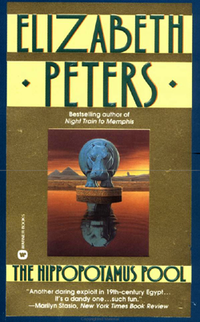
Hippopotamus Pool

by Elizabeth Peters

Book eight in the mystery series featuring Amelia Peabody is much like the previous books - enjoyable, satisfying, informative, humorous and cozy.

This season (1899-1900), the Emersons are greeted in Cairo by a mysterious Mr. Shelmadine, who tells them a tale of reincarnation and a queen's tomb before disappearing. The tomb he wants them to excavate is at Drah Abu'l Naga, the tomb of Queen Tetisheri. Despite Emerson's annoyance at the melodrama, his interest is piqued, especially after a corpulent and ruthless antiquities dealer named Riccetti mentions their visitor in a veiled warning.

While trying to find the exact location of the tomb, as well as the vanishing Mr. Shelmadine, the Emersons meet up with David Todros, a young apprentice to an accomplished forger of antiquities. David is Abdullah's grandson, who scorns the "Inglizi" and wants nothing to do with Abdullah, until he himself becomes a target for violence connected with the Emersons' quest.

Evelyn and Walter Emerson come to join the work as well, and Ramses, Nefret, and David begin what is to be a beautiful friendship.

Tuesday, April 22, 2008

The Colony of Unrequited Dreams

by Wayne Johnston

I didn't expect to like this book as much as I did. The novel is about Newfoundland and centers on Joseph Smallwood, the real-life political figure who ushers the country through confederation with Canada and then becomes the first premier.

In writing a work of the imagination in part inspired by historical events, Johnston wanted “to fashion out of the formless infinitude of ‘facts’…a work of art that would express a felt, emotional truth... Adherence to the ‘facts’ will not lead you safely through the labyrinthine pathways of the human heart.” Johnston was 19 when he met the real Joe Smallwood; he was just starting out as a journalist, and Smallwood was less than complimentary about Johnston’s reporting. Although the politician died only in 1991, little was written about his life before the age of fifty, allowing Johnston some license to imagine his formative influences.

“I wanted to write a big book about Newfoundland in scope and in vision. I couldn't think of a bigger character whose life touched on more themes, involved the whole of Newfoundland more completely than Smallwood did.” Smallwood saw Newfoundland in terms of “unrealized talent and unfulfilled ambition”; his life was somehow emblematic of the land. Moreover, says Johnston, “He was so prone to making mistakes and so fallible, and he combines so many contradictions in his personality. His quest, like that of many great literary figures of the past century, is to overcome these divisions.” The completely invented character of Fielding, meanwhile, “is like me”, says Johnston. “I share her view of Newfoundland.”

The title of the book, Johnston says, evokes “the nostalgia Newfoundlanders have felt for the possibilities of the island, and that they still have for the future. Joe is always searching for something commensurate with the greatness of the land itself, but he can't find it, and it's driving him mad…Newfoundland is that kind of place. It makes you want to live up to the landscape, but on the other hand it offers you no resources to do so. There's always this constant yearning that at least for my part helped me to start writing.”

You can read more of Johnston's essay about Unrequited Dreams by clicking on the link.

Johnston creates a larger-than-life character in Sheilagh Fielding who counterbalances Smallwood's smaller-than-life personality. It was their relationship that most engaged my interest. I was happy to discover that Johnston has written a whole novel about Fielding, titled The Custodian of Paradise. Next to Newfoundland itself, Fielding was the most complex character. She had depth, mystique, struggles and strength. Whereas Smallwood lacked all those traits. And yet, on the surface he appears to be an upstanding citizen and she a retrobait.

Most of the book is told in the1st person narrative with sprinklings of personal letters, Newfoundland history, and newspaper articles written by Fielding. I thought this was a very effective way of helping the reader understand Newfoundland better and to provide other views of events and people than just Smallwoods.

I would love to sit in on book discussion groups all across Newfoundland when they are discussing this book. The treats would definitely take a back seat to the lively and emotional discussion. To many in Newfoundland Smallwood is a hero and to the rest he is a traitor. I can understand both sides. Actually, I would welcome a good discussion of this book with any bookclub.

I would like to have had a map of Newfoundland with major areas and cities highlighted and also a map of St. John's included in the book. I lived in St John's when I was little and visited there this summer, but was unfamiliar with the area called the brow. I am assuming it's the peninsula of land where Ft Amherst Lighthouse is located.

I highly recommend this book. If you have any connection to Newfoundland it's a must. If you don't, I think you'd still be immensely satisfied.
Sunday, April 20, 2008

The Carpet People

by Terry Pratchett

The appeal to me was first, the book was written by Terry Pratchett; second, it was first published when Pratchett was 17-years-old, and third, it was revised by Pratchett, age 43, when the book was re-released.

Pratchett said in 1992 when the book was republished, "I wrote that in the days when I thought fantasy was all about battles and kings. Now I'm inclined to think that the real concerns of fantasy ought to be about not having battles, and doing without kings." That was my final summarizing thought when I finished the book - This book is about battles.

Pratchett's humor is evident and the story was okay, it just wasn't one of my favorite. I can see how it may be interesting for someone in Jr. High.

Thursday, April 17, 2008

Amazing Maurice and His Educated Rodents

by Terry Pratchett

The American cover is not the least bit cute or enticing, so I'm showing the English version even though that's not the one I was able to hold in my hands.

Some books I've read recently are based on fairy tales; this book takes the Pied Piper tale and "turns it right on it's head" according to the front cover. I think that's an apt description. Maurice is a talking cat who has teamed up with a "stupid-looking boy" and some talking mice in a Pied Piper-like scam.

Pratchett's characteristic humor defuses the ick factor allowing me to actually like the rats and tolerate their environment. In fact, I found myself cheering for the rats, which is to be expected since they are the heroes along with Maurice, the boy and a town girl.

I found myself thinking this was the perfect book to engage the interest of young boys. Although, I need to add a word of caution: the book gets quite terrifying in the last half. I didn't have any nightmares, but I could imagine that some children might. I think this book should be categorized as YA, not children's. The scary part ends and the book finishes on a lighter note. I really liked this book and highly recommend it to adults and cautiously recommend it to young adults.

The Amazing Maurice and His Educated Rodents was awarded the Carnegie Awards in 2001. This award is given for outstanding children's or YA literature.

Friday, April 11, 2008

Anne of Avonlea

by L.M. Montgomery

When I finished reading Anne of Green Gables I had no intention of reading any further. I couldn't imagine the story could carry on with any of the freshness of the first book. Lucky for me, I met Raidergirl3 while Candleman and I were visiting Prince Edward Island and she gave me Anne of Avonlea and Anne of the Island.

I love these books. Can't believe I didn't read them when I was young, but I'm certainly glad, that at 57, I did read them.

In this installment we meet the delightful Philippa who is one of Anne's friends at college in Nova Scotia. Let me just share this one interchange between Philippa, Anne and Priscilla when the girls first meet. Philippa begins with, "Tell me, what do you think of my looks?" At this naive demand, made in a perfectly serious tone, Priscilla laughed again. But Anne said, impulsively squeezing Philippa's hand. "We thought this morning that you were the prettiest girl we saw at Redmond." Philippa's crooked mouth flashed into a bewitching, crooked smile over very white teeth. "I though that myself,: was her next astounding statement, "but I wanted some one else's opinion to bolster mine up. I can't decide even on my own appearance. Just as soon as I've decided that I'm pretty I begin to feel miserably that I'm not. Besides, I have a horrible old great-aunt who is always saying to me with a mournful sigh, "You were such a pretty baby. It's strange how children change when they grow up." Please tell me quite often that I am pretty, if you don't mind. I feel so much more comfortable when I can believe I'm pretty. And I'll be just as obliging to you if you want me to - I can be, with a clear conscience." "Thanks," laughed Anne, "but Priscilla and I are so firmly convinced of our own good looks that we don't need any assurance about them."

I laughed at this description Philippa gives of Mrs. Grant: "She is a sweet old thing; but she never says anything but good of anybody and so she is a very uninteresting conversationalist."

I hope I always remember this bit of wisdom from Aunt Jamesina: "Anybody is liable to rheumatism in her legs, Anne. It's only old people who should have rheumatism in their souls, though. Thank goodness, I never have. When you get rheumatism in your soul you might as well go and pick out your coffin."

I strongly encourage you read these books if you want to brighten your day.

Wednesday, April 09, 2008

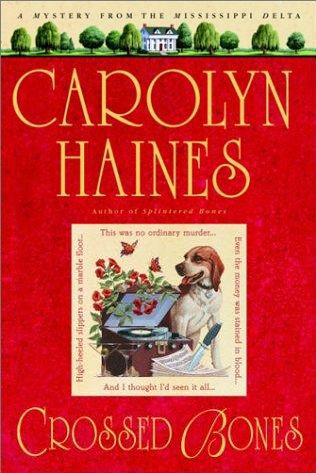
Crossed Bones

by Carolyn Haines

I discovered Carolyn Haines' mystery series when I decided to do my Themed Reading Challenge using books that had the word bone in the title. (That's how I stumbled across Kathy Reich's novels, too)

This series features Sarah Booth Delaney as a private investigator in the Mississippi Delta. There's a good mix of humor, friendship, forbidden love and a satisfying mystery. The characters are human and Southern. I can't say the characters are real, because one reappearing character is a figment of Sarah Booth's imagination.

I have enjoyed reading two from this series - neither one in the correct order. Someday I'm going to start at the beginning, but I don't think it's hindered my enjoyment that I've been hit-and-miss so far. I love the covers on the earlier books with the square in the middle.

Tuesday, April 08, 2008

Sixpence House: Lost in a Town of Books

by Paul Collins

I mooched this book last year during the Something About Me Challenge. It was one of the books Nattie listed as one that told something about her. The part of the title - Lost in a Town of Books - naturally drew my interest. I didn't get it read for the Something About Me Challenge, but since it was on my shelf, it was available for some of this year's challenges.

Sixpence House is a memoir of Paul Collins' experiences in the bookish town of Hye-on-Wye. He moved from San Francisco to the small community in the Welsh countryside.

One of my favorite parts of the book was Collins' comparisons of things English with things American from aspects of daily life to food and architecture. For example, the shower: "Every shower in Britain has some sort of Heath Robinson mechanism who devised for all British showers cheap plastic box with tubes that go nowhere and buttons that do nothing, except for the one that will scald you. Apparently it is some kind of filtration system for removing any pleasure one might have in washing. When I was a little boy in America, the pounding water pressure would allow me to stand with my eyes closed in the sower and imagine that I was flying a wounded P-57 back to base, with rain whipping into the cockpit; or to pretend that I was getting heroically smashed against a brick wall by a water cannon wielded by riot police. But I'm not sure what British boys can imagine in their showers. {Perhaps they pretend that they are standing under a rusted and leaking pipe in an unlit boiler room. Or that someone is weeing on them from a great height." (I've experienced showers just like that in America.)

Collins told about his love of literature that developed when his parents would go to antique sales. He always came away from those sales with books. He especially like old science books. "My most beloved book was a relative youngster: a 1951 volume by Willie Ley called Rockets, Missiles and Space Travel. And yet the creamy plate paper, the yellow embossing of a pointy fifties sci-fi rocket on the cover, the feeling of reading Ley's speculations on a moon shot and knowing more than the author did - the true classical sense of irony, where the audience is aware of the ending even as the players of history are not - these things appealed to me in a way that I couldn't explain." As a science teacher I used to experience this feeling often.

I laughed and was amazed at this accounting: "This is a country where citizens will not grumble or take action at much of anything unless it interferes with their cup (of tea). Some years ago, a species of English tit bird discovered that if they pecked through the foil cap on milk bottles, they could suck down a cream feast so sumptuous that they could barely stagger away afterward on their little bird feet. Other varieties of tits quickly learned by watching, and suddenly the nation's cream teas was in moral peril; whereupon redesigned bottle caps were procured with impressive alacrity."

I enjoyed this morsel from a letter from Helen Hunt Jackson to Emily Dickinson(before Dickinson was well published): "I have a little manuscript volume with a few of your verses in it - and I read them very often - You are a great poet - and it is a wrong to the day you live in, that you not sing aloud." I think we could all take that counsel to heart - whatever our gifts and talents are we should share them with those around us.

All-in-all I really enjoyed Sixpence House. I found myself wondering if I could ever convince Candleman to spend a year in the Welsh countryside.

Monday, April 07, 2008

Messenger of Truth

by Jacqueline Winspear

Book four in the Maisie Dobbs Mystery series is every bit as good as the others and there's more tension and suspense. Maisie is called upon to discover if the accident that killed an artist was really an accident or if it was murder. In her pursuit to find the truth, she questions her motives in becoming a private investigator. In the end she does uncover the truth of the accident and discovers some things about herself as well.

I liked this passage towards the end of the book:
The sea lapped even closer; though Maisie remained in place, her hands holding her collar to protect her neck. It's because it's the beginning, and also the end. That was what she loved about the place where the water met the land - the promise of something fresh, a suggestion that, even if what is happening now is to be suffered, there is an end and a beginning. I could sail away on that beginning, thought Maisie.
I already have book five and I've added it to my list for the Cardathon Challenge so I'll be able to read it in the near future.